The company behind the platform
TRASYA Lojistik moves freight across borders by road, sea, and rail, backed by warehouse and terminal services in Istanbul. Multimodal logistics is coordination-heavy by nature: loads, vehicles, drivers, customers, suppliers, and documents all have to stay in sync — and until this platform, much of that coordination lived in phone calls and spreadsheets.
What we built
A monorepo platform with three faces and one backend:
- Partner portal (Vue 3) — the operations cockpit. Loads, jobs, drivers, driver applications, vehicles, customers, suppliers, contacts, documents, announcements, and role-based user management, all in one place with granular per-permission access control.
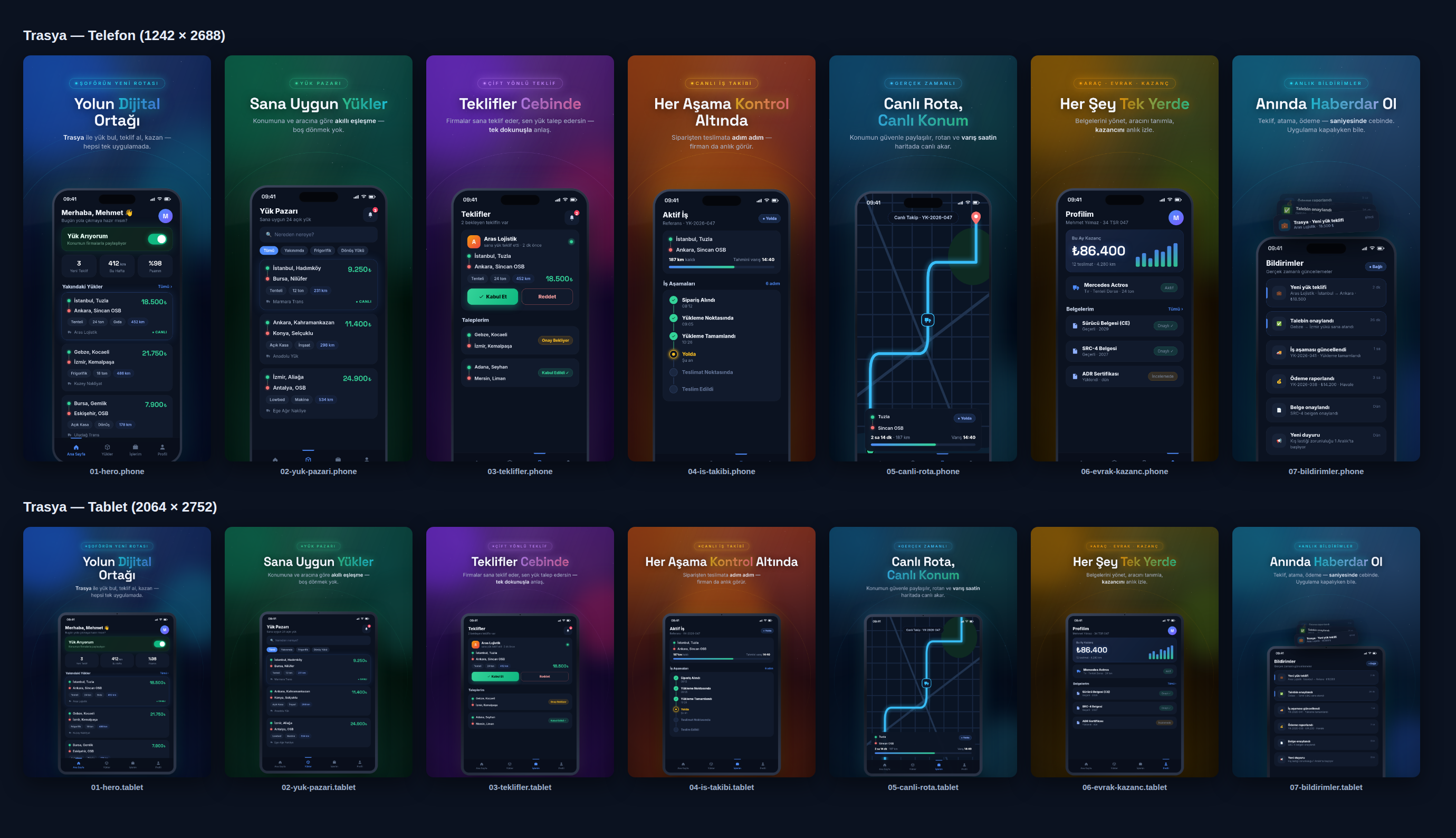
- Driver app (Flutter) — drivers receive load offers on their phones, accept or decline, and follow their assigned jobs. Localized, with separate dev/prod build flavors and push notifications.
- Admin panel (Vue 3) — internal management of tenants and users.
The load lifecycle, in real time
A load is defined with pickup and dropoff locations (with map coordinates), scheduled time, cargo type and weight, price, distance, and an optional recurrence. From there the flow is live: the operator offers the load to selected drivers, the offer lands on their phones instantly over a realtime channel, and every response — accepted, assigned, withdrawn — is broadcast back to the portal the moment it happens. Presence tracking shows who is online. No refresh buttons, no "did you get my message?" calls.
Under the hood
The backend runs on Bun + Hono with PostgreSQL and Prisma — a deliberately lightweight, fast stack. Platform concerns are separated into their own modules: multi-tenancy, payments, notifications, file storage, and realtime broadcasting. JWT authentication uses audience separation, so a partner token and a driver token are structurally different things. The whole API surface is documented with OpenAPI.
Why it matters
Logistics software succeeds or fails on one question: does the dispatcher trust the screen more than the phone? Real-time offer flows, presence, and a single source of truth for loads and fleets are what earn that trust — and what turn a transport company's institutional knowledge into infrastructure.
App Store & Google Play
The Trasya driver app is published on the Apple App Store and Google Play. Store-facing legal pages for the app: